Hybrid & Electric Vehicle Corner
by: Curt Ward
Professor at Joliet Junior College
Thermal Management Systems
As I write this article, spring break is behind us, the weather has begun to get warmer, and the automotive instructor conference season is in full swing. With warmer weather the subject of air conditioning becomes a bigger part of the classroom discussion and lab activities. An up-to-date curriculum on this subject will include the thermal management systems of electric vehicles. In this article I will highlight some of the thermal management topics that I believe should be included in this discussion.
 Let’s begin with high-voltage safety. Most electric vehicles use a high-voltage electric air conditioning compressor to cool the passenger compartment, the high voltage battery and the power electronics. Before servicing the compressor, it is important to safely depower the high-volage system. The processes vary. Some vehicles may still require the removal of a high-voltage disconnect, while others may accomplish this task with a low-volage disconnect or with a scan tool. It is important to not only follow the correct procedures, but also to verify the system has been properly shut down with a multimeter before proceeding with any repairs. Always wear the proper personal protective equipment when removing the high voltage disconnect and verifying the absence of voltage.
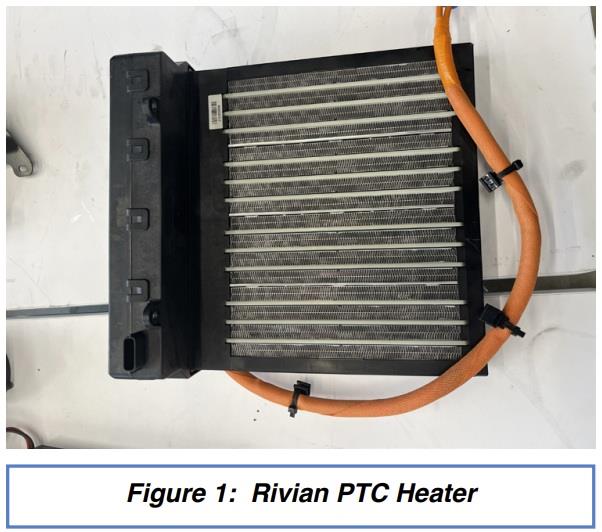
Historically, high voltage PTC heaters were used to heat the coolant or air
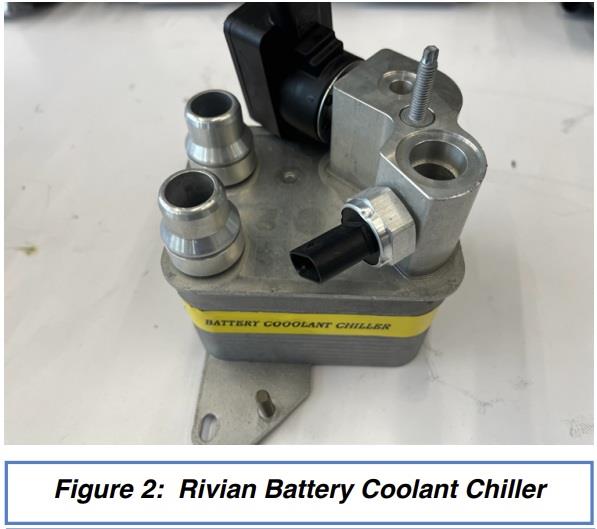
that was used to warm the passenger compartment and a traditional air conditioning system, with the addition of a chiller, was used to cool the passenger compartment, the high voltage battery and the power electronics (Figure 1 – Rivian PTC Heater and Figure 2 – Rivian Battery Coolant Chiller). These systems worked well, however, the electricity required for their operation reduced the driving range. This reduction is particularly noticeable when ambient temperatures drops below freezing. To reduce the effects of the passenger compartment heating and cooling on driving range, many manufacturers are switching to heat pump systems.
A heat pump is basically a reversible loop air conditioning system that provides both cabin heating and cabin cooling. In addition to pulling heat from the outside air, some heat pump systems capture energy by recycling waste heat from power electronic modules, drive motors, on-board chargers, the battery pack, and inverters to warm the passenger compartment. In the heating mode, the external condenser absorbs heat from the atmosphere and the heater exchanger, located in the evaporator housing, releases the heat into the passenger compartment. The main component of the heat pump is a super manifold that combines the traditional cooling and refrigeration systems into a single unit for thermal management (Figure 3 – Rivian Super Manifold). Another feature of many heat pump systems is the liquid-cooled condenser. These systems are typically more efficient than an air-to-refrigerant condenser ahead of the radiator. These systems have the same requirement for the correct airflow and refrigerant charge as a conventional climate control system.
The diagnosis of a heat pump system is unique when compared to a conventional air conditioning system. Some of the additional checks 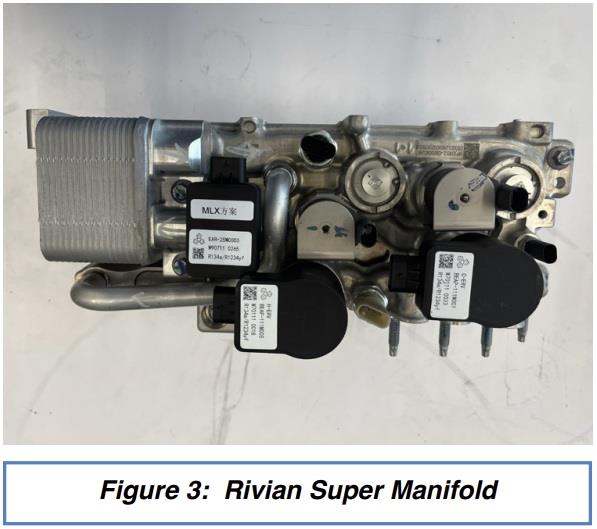 include vibration and noise resonance diagnosis due to the high operation speed of the compressor. Insufficient coolant or refrigerant levels will more quickly impact heat pump operation. The operation of drivetrain inverters and motors and coolant valves is critical as the system relies heavily on scavenged heat. The most significant downside of a heat pump system is their diminished effectiveness in sub-zero temperatures. A vehicle that is operating in these conditions will rely more heavily on backup PTC heaters to warm the passenger compartment.
If you are teaching a traditional air conditioning class or covering thermal management in a hybrid and electric vehicle curriculum, it is important to include the heat pump systems in the discussion of the many types of systems that are used to heat and cool the powertrain and the passenger compartment.
I will finish this article with the same offer I make after each of my presentations. If you are interested in getting started in the process of adding hybrid and electric vehicles to your curriculum or want more information, please feel free to reach out. I am more than willing to sit down in-person or online and share my experiences. Are you looking for a classroom textbook? Reach out to Pearson and ask for a review copy of the all-new Electric and Hybrid Electric Vehicle text that Jim Halderman and I co-authored. It is a comprehensive text covering all the latest information on the subject.